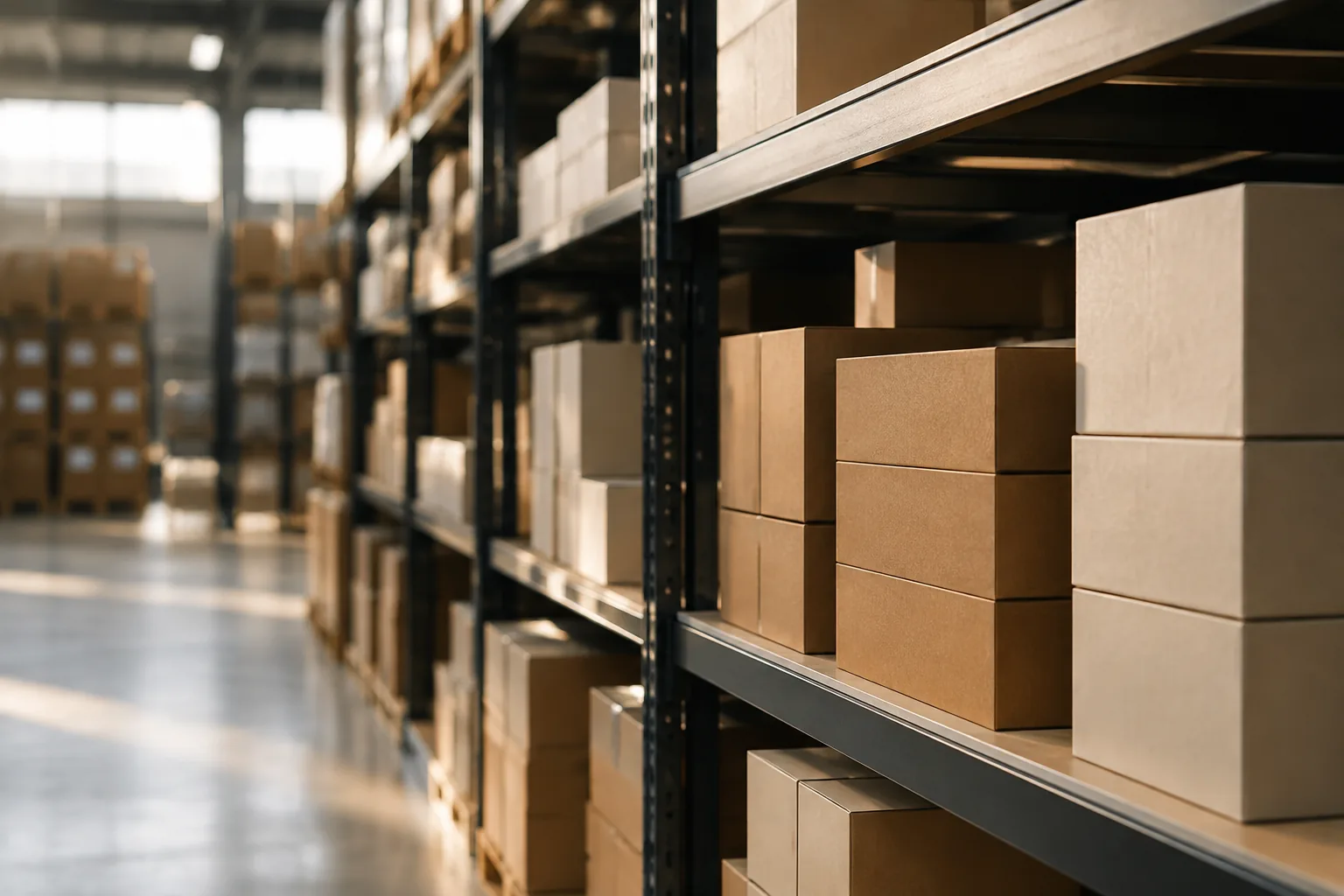
If you are moving from packing orders at your kitchen table to working with a fulfillment operation, the vocabulary is new but the logic is not: goods arrive, get stored accurately, get picked against real orders, get checked, packed and dispatched, and report back at every step. This article walks that full loop as it actually runs on a warehouse floor. It is written for founders and operators who want to evaluate a fulfillment partner or run their own operation without learning each lesson at customer expense.
Fulfillment is not storage. Storage is one station in a daily loop that repeats for every order: Inbound → Storage → Order Sync → Pick → QC → Pack → Dispatch → Tracking. The loop matters more than any single station, because an error introduced at one step is inherited by every step after it. A bad stock count becomes an oversell; an oversell becomes a cancellation; a cancellation becomes a review you did not price into the order. Understanding the loop is therefore not background reading — it is the checklist you will use to judge whoever fulfills for you.
Inbound: where most problems are prevented or created
Every unit you will ever sell enters the operation through receiving, which makes inbound the cheapest place to catch problems and the most expensive place to skip them. A disciplined inbound process receives against a packing list, counts what actually arrived, inspects for transport damage and specification drift, and shelves goods into named locations the same day. Anything that fails — short shipment, damaged cartons, wrong variant mix — is documented and flagged to you while the claim is still worth making against the supplier or carrier.
The alternative is common and expensive: cartons are accepted, moved to a corner, and counted "eventually." When stock finally becomes sellable nobody can say what arrived, what was damaged, or which batch has the packaging defect your first reviews will mention. If you are sourcing from China, the fix is upstream and simple: have goods inspected before they leave the factory, so inbound verifies a known quantity instead of discovering one. Our quality and inspection process covers those pre-shipment gates.
Storage: the records that make every later step possible
Storage sounds passive, but it is where inventory truth is manufactured. Two practices separate operations you can plan against from operations you must babysit:
- Location-level tracking. Every unit sits in a named bin, shelf or zone, and the system knows which. "4,000 units in the warehouse" is not a record; "3,840 units across bins A-12, A-13 and B-02, 160 quarantined pending inspection" is.
- Cycle counting. Instead of one annual stocktake that freezes the operation, a rotating sample of SKUs is counted every week. Variance is investigated immediately, while the cause is still traceable — a mis-scan, an unlogged return, a picking error — rather than absorbed into a year-end write-off.
The symptom of weak storage discipline is familiar to any growing brand: your store dashboard says one number, the shelf says another, and the gap shows up as either oversells or dead stock you did not know you had. Once stock records cannot be trusted, every downstream promise — delivery dates, product availability, restock timelines — becomes a guess.
Order sync and picking: removing the human copy step
Orders should flow from your store to the warehouse system automatically — platforms like Shopify, TikTok Shop and Amazon all support it, and manual order entry should be the rare exception, not the daily process. Manual entry adds a copy step between your customer and the warehouse floor, and every copy step is an opportunity for the wrong variant, the wrong address or a missed gift note.
Picking is the step customers experience most directly, because a picking error ships the wrong product to the right person. Professional operations use scan verification: the picker scans the bin location and the item barcode, and the system confirms the match before the item enters the tote. Batch picking groups orders by zone for efficiency; single-order picking trades some speed for simplicity. Either way, the mechanism that matters is verification at the moment of the pick — not a retrospective apology email.
QC before pack, not after the customer
The check station between pick and pack is your last chance to catch an error while it is still internal. Effective check-before-pack confirms the items against the order line by line, inspects for damage or defects that storage may have hidden, and verifies pack standards for the SKU — fragile items get their protective materials, apparel gets a size check, multi-item orders get a completeness check. Errors caught here cost minutes; the same errors caught by a customer cost a refund, a reshipment and usually a public review.
Packing: standards per SKU, not one box for everything
Packing looks trivial and is not. The difference between a parcel that survives the carrier network and one that arrives crushed is usually a written pack standard: which box size, which protective material, which sealing method, which label placement. Standards also protect your margin — oversized boxes raise shipping cost through dimensional-weight pricing, and under-protected goods raise it through damage claims. Branded inserts and presentation belong in the same written standard, so the unboxing you designed is the unboxing that ships.
Dispatch and tracking: the promise-keeping steps
Dispatch is where the operation commits to a carrier and a cutoff. Orders are labeled, manifested and handed to the carrier program matched to the lane and the promise date — express for urgency, economy lines where the customer chose price over speed. After handoff, tracking events should flow back into your store and your support tools automatically. This is not a cosmetic feature: a large share of "where is my order" tickets exist simply because tracking status was never visible to the customer. Event-level visibility turns those tickets into self-service answers.
Where the loop usually breaks
The loop fails in predictable places. The table below is the audit checklist we suggest you apply to any fulfillment operation — your own or a partner's.
| Stage | Typical failure | What good looks like |
|---|---|---|
| Inbound | Cartons accepted without count or inspection; discrepancies discovered months later | Same-day receiving against packing list, with discrepancy reports while claims are still valid |
| Storage | Dashboard and shelf disagree; nobody knows which is right | Location-level records with scheduled cycle counts and variance investigation |
| Order sync | Manual re-entry of orders; variants and addresses get copied wrong | Automated sync from the store, with daily reconciliation of order counts |
| Pick | Wrong variant or wrong item picked from a paper list | Scan-verified picking; errors stopped at the shelf, not at the customer |
| QC / Pack | One packing method for every SKU; damage and oversize costs both rise | Written pack standards per SKU, checked before sealing |
| Dispatch | Orders miss carrier cutoffs silently during busy weeks | Cutoff monitoring with same-day escalation when the clock is at risk |
| Tracking | "Where is my order" answered by guessing | Carrier events synced to the store; exceptions enter a managed queue with owners |
None of these failures is exotic. That is the point: fulfillment quality is mostly the unglamorous discipline of running the same eight steps the same way at any volume, and measuring the places where the steps drift. When you evaluate a fulfillment partner, ask how each step is documented — and what happens, specifically, when it is not followed.
Frequently asked questions
What is the difference between a 3PL and dropshipping fulfillment?+
A 3PL fulfills from inventory you already own and have placed in the warehouse, which supports branded packaging, faster domestic delivery and tighter control. Dropshipping fulfillment manufactures or sources on demand per order, so you carry no stock but inherit longer delivery times and less control over presentation. Both run on the same eight-step loop; they differ in where inventory sits and who owns it. Our dropshipping operations page covers the on-demand model.
How long does onboarding with a fulfillment partner take?+
It depends on SKU count, integration complexity and whether inbound stock is already inspected. A structured onboarding maps every SKU to locations, connects your store and tests order sync, runs a small trial batch through the full loop, and signs off pack standards and exception rules before volume moves. Be cautious of any provider that cannot describe this sequence specifically.
How is ecommerce fulfillment priced?+
Typically by the work performed: inbound receiving, storage by volume occupied, pick and pack per order, packing materials, and shipping by lane. A quotable provider itemizes each component so you can model total cost against your own order profile instead of comparing one blended number. You can request an itemized fulfillment quote with your SKU and volume details.
Do I need a certain platform or sales channel to use professional fulfillment?+
No. Shopify, WooCommerce, TikTok Shop and Amazon workflows are all commonly supported, and the practical requirement is simply that orders sync automatically and tracking events flow back. Confirm integrations during onboarding rather than assuming them, and ask how multichannel brands keep one pool of stock from overselling.